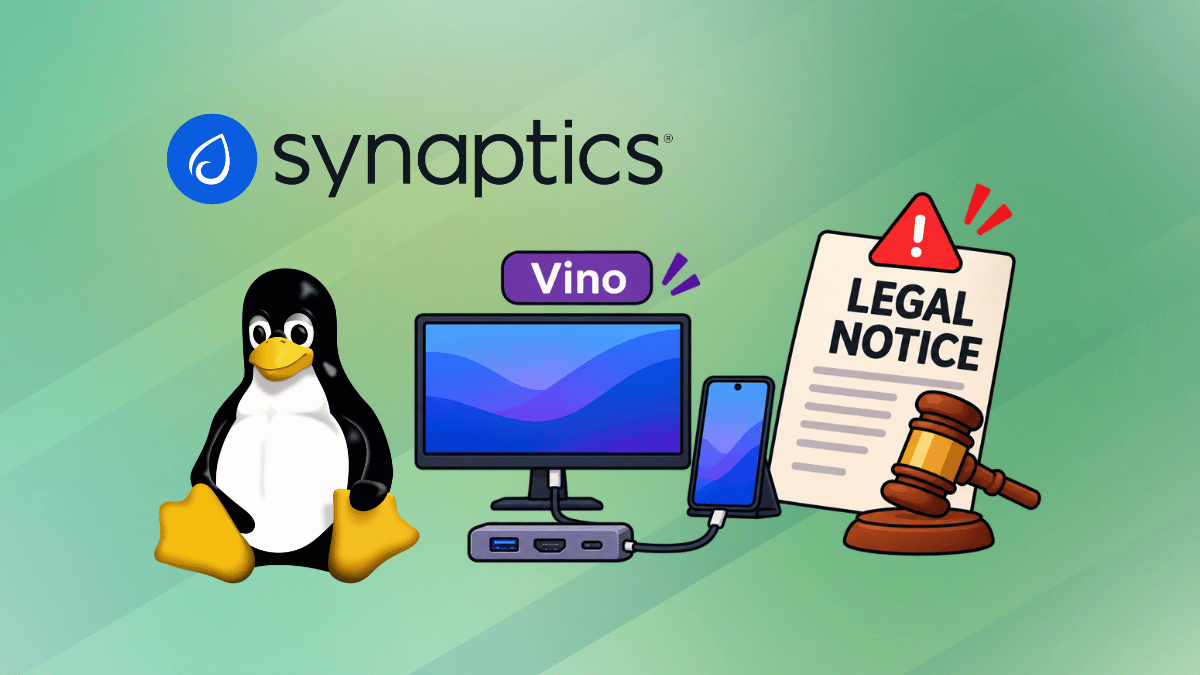
The AI-Assisted Linux Driver for DisplayLink Gets Legal Notice
cross-posted from: lemmy.ml/post/55185885
Before we dive into the matter, you first have to understand what DisplayLink is. It is a proprietary graphics transport technology that lets computers connect to one or more external displays over USB, using docks or adapters built around DisplayLink chips.
It works by compressing display data on the host computer and sending it to a chip in the connected device. The chip then decodes it for output to monitors through interfaces such as HDMI or DisplayPort.
On Linux, this support can rub some people the wrong way due to its closed-source nature. That is where Mike Lothian’s (FireBurn) Vino comes in as an open alternative.
Unfortunately, Synaptics owns DisplayLink and has sent Mike cease-and-desist letters alleging that he infringed its DisplayLink patents with his project.
What’s Vino?
Vino is a driver that lets the Linux kernel talk to DisplayLink docks directly. It is meant to replace DisplayLink’s closed-source software and the open source EVDI kernel module that sits beside it.
Mike wrote it with help from Claude Code, and the first version reached the kernel mailing list in June, unfinished. He had faced a communication issue between the dock and the driver and asked other developers for help.
In early July (courtesy of LWN.net), he emailed a Synaptics employee for guidance and mentioned his Rust rewrite of EVDI. About two weeks later, a different employee replied.
That reply said his Rust rewrite of EVDI was not a thing of concern. Rather, the concern was the DisplayLink protocol and codec, which Synaptics believes are covered by its patents.
Lawyers get involved
A cease-and-desist letter followed on August 17. It told Mike to stop development and withdraw anything he had submitted to maintainers and hosting sites, with a signed confirmation due by August 28.
An appendix listed over 125 patents without saying which applied. Mike posted a working version 3 of Vino on August 26 and asked Synaptics the next day which claims they had in mind.
The answer came in October as claim charts. They map one claim from each of two patents, GB2484736 and GB2485613, to his source code.
The October 5 letter said Synaptics would seek $25,000 for the cost of preparing those charts if Mike missed an October 11 deadline, with the figure rising by at least $25,000 each week.
Mike replied on October 6 (message 8) with an offer to pause public work on the encoding code the charts point to if Synaptics paused the deadline and the weekly charge. He also asked about licensing that code for non-commercial use.
On October 7, Synaptics said it would grant no patent license or promise not to sue and set October 18 as a final deadline.
What I can see so far is a very aggressive patent infringement witch hunt against a lone open source developer who was quite open to communication.
Synaptics took about three weeks to answer his request for specifics, then followed with a potentially life-ruining $25,000 demand that compounds weekly.
Clean room design quirks
Mike describes Vino as a clean-room driver and says he reverse engineered it from captured USB traffic and vendor programs.
If you didn’t know, in a clean-room recreation, one party studies the original implementation, then writes a description, and a separate party builds the new code from that description alone.
It is meant to act as a defense against copyright claims because it shows nothing was copied. Synaptics’ July reply argues that clean-room or independently written code can still infringe a patent.
The timing
Vino also lands in a busy stretch for AI-assisted reverse engineering, from smart TV cleanups to office suite clones. Legal pressure has reached other AI-built projects too.
Mike has already taken down the Vino repository in response to the demands, and Synaptics has not made a public statement so far.
Only time will tell what happens to the work, and I hope someone forked it before it went offline, as that would give others a good starting point to build on.
#technology
8244 posts · Last used 6h


Microsoft outage: Microsoft 365, Teams, Outlook, Copilot all impacted






Microsoft outage: Live updates as mass issues reported with Outlook, 365
How’s everyone enjoying their half day of no emails
Your Smartphone Camera Could Get a Big Upgrade With This Tech

Trying Tourette's device tested by Lewis Capaldi was the best day of my life
cross-posted from: piefed.social/…/trying-tourette-s-device-tested-b…
When Katie was just a child, her tics were so relentless they left her bedridden with a sore throat for two weeks.
The now 15-year-old says living with Tourette’s affected her ability to sleep, eat, and caused her to miss school.
But a wrist device developed by researchers in Nottingham helped her calm down in an “instant”.
Katie recalled trying it on for the first time, and said: “It was absolutely life-changing. It was like the best day of my life.”


Nvidia is now in a post-Jensen Huang world — here's why that could be a disaster for PC gamers: Heaping misery on top of the GPU crisis.


Former Nvidia CEO Huang had a relationship with a second employee, sources say
Mistresses are being discovered at an ever increasing rate.

Vivaldi CEO explains his anti-AI stance: most users don’t want AI in the browser
Jon von Tetzchner, CEO and founder of Vivaldi Technologies, refuses to integrate AI features in its browser and wants human engineers, not AI, to write its code.


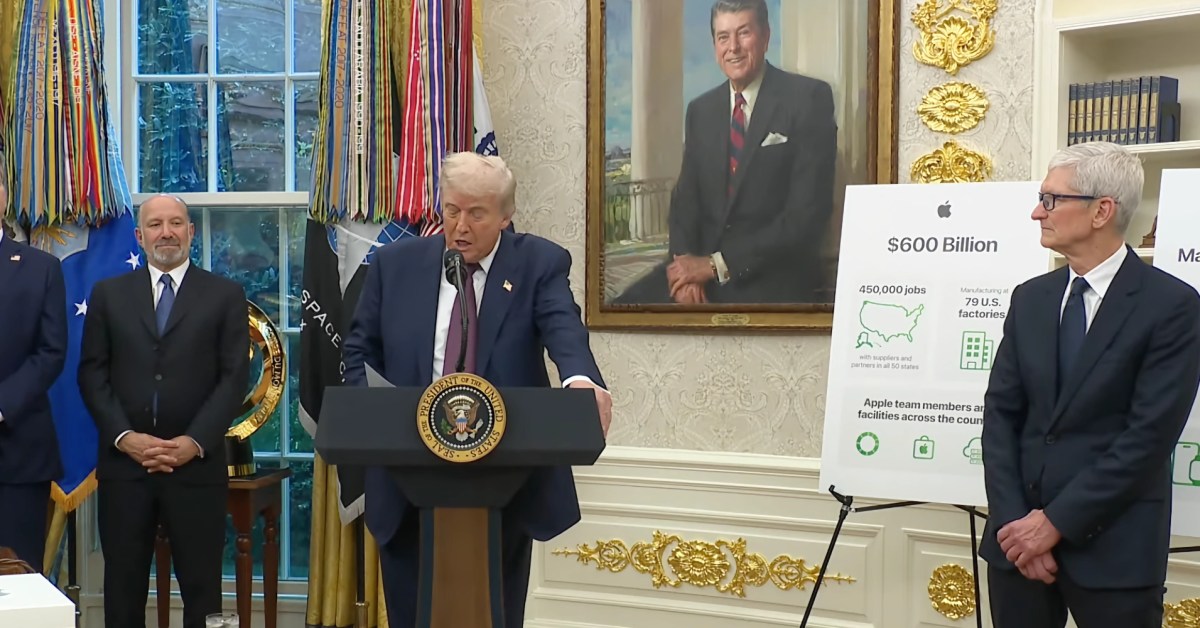
President Trump calls on Tim Cook to be next NVIDIA CEO - 9to5Mac


Taiwan’s chipmaking giant TSMC to invest $1B in Anthropic, OpenAI: Latest example of the AI boom’s circular financing comes as AI trade wobbles.

Apple has new Mac app coming to make running local AI models easy

UK Government 'looking seriously' at banning under-16s from Vinted and eBay
The move was due to fears that messaging functions on the platforms allowed strangers to groom children, according to the newspaper. It suggested similar reselling platforms, Depop and Facebook Marketplace, would also be included in the list of banned sites.
I don’t even know what to say to this LOL.

T-Mobile illegally imposed 50GB cap on low-income home Internet plan, NY says: Law requires 25Mbps home Internet. T-Mobile lowers speed to 600Kbps after 50GB cap.

Nvidia’s Board reportedly preparing to oust CEO Jensen Huang as second extra-marital affair emerges — stock has plunged 20% since scandals began, Huang has been first and only CEO for 33 years.



Nvidia prepares to oust Jensen Huang, WSJ reports — stock sinks


Nvidia CEO Huang allegedly involved in a second affair with an Nvidia exec
